Bib design gets all the attention, but on race morning the humble question of how the bib actually stays on the runner is what generates complaints, torn shirts, and mistimed finishes. If you organize events, the attachment method is a procurement decision you make on every runner’s behalf, and it interacts with the bib material, the timing system, and your budget. This guide lays out what to bundle in the packet, when the standard approach falls short, and how the alternatives really compare once you multiply them across a full field.
The default that works: four pins, four corners
The reason nearly every race hands out safety pins is that four pins in the four corners is a genuinely good solution. Four is the standard for a reason: pinning only the top two corners lets the bib flap, which is noisy, catches wind, and makes finish-line photos and manual number-reading harder. All four corners hold the bib flat against the torso where it should sit, across the abdomen rather than high on the chest. Pins are close to free, need no instructions, and work on any shirt. For the overwhelming majority of 5Ks, charity runs, and school events, a small envelope of four pins in the packet is the correct answer and the story ends there.
What pins cost you beyond the pins
The friction with pins is not the price, it is the side effects. They put four holes in a shirt, which runners resent on a favorite technical top, and they interact badly with two things you may have designed into the bib. If you use Tyvek versus standard paper bibs, a pin hole in paper can become a tear-out under wind load, so a lightweight paper bib pinned at only two points is asking to be lost on course; Tyvek’s tear resistance tolerates pins far better. The second issue is timing. If your bibs carry an RFID chip on the back, a pin driven through the chip or its antenna can kill the read, so your packet instructions and the bib art should steer pins to the corners and away from the printed chip zone. None of this argues against pins; it argues for four of them, placed correctly, on a bib material that can take them.
The alternatives runners actually buy
Beyond pins sits a small market of reusable attachments that solve the shirt-hole problem, and it helps to know what they are even if you never stock them. Bib magnets use a set of four magnet pairs to hold the bib with no holes, though they can be dislodged by a hard bump and are a loss risk on an expensive item. Snap-style holders, two plastic or metal pieces that clamp through the shirt and bib, are reusable hundreds of times and can even be branded, but they cost real money per set. Elastic bib belts, popular in triathlon, clip the bib to a waist strap so it can rotate from back to front, and they never touch the shirt at all. The catch across all three is cost, and the gap versus pins is not small.
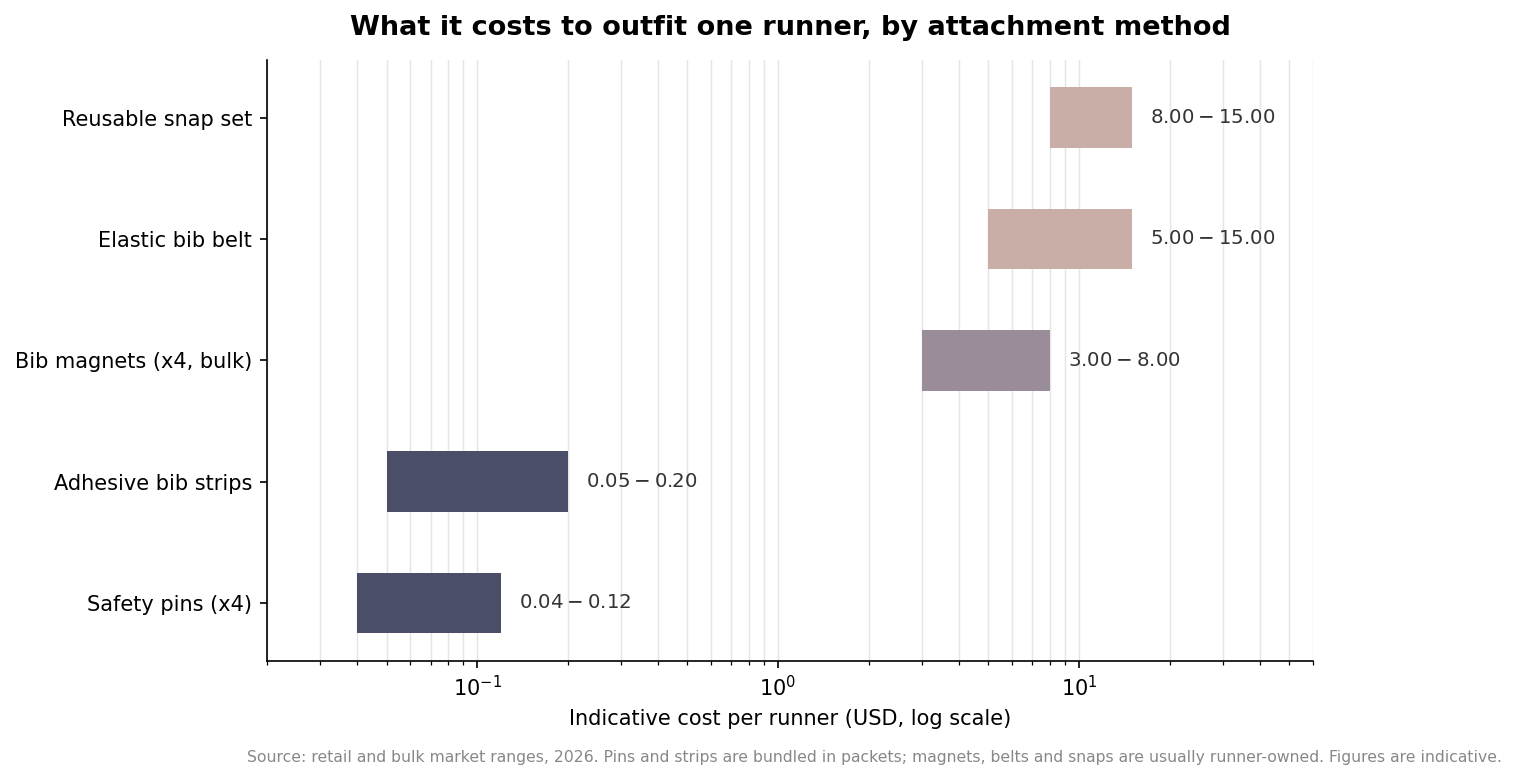
Read that chart as two tiers. Pins and adhesive strips are packet-economical, in the range of a few cents per runner, which is why they are the only two methods most organizers ever bundle. Magnets, belts, and snap holders live one or two orders of magnitude higher because they are durable goods designed to be reused across many races. That reusability is genuine value, but it accrues to the individual runner who races often, not to an organizer outfitting a one-time field. The sensible division of labor is to supply pins and let frequent racers bring their own belt or snaps if they prefer.
Why organizers still bundle pins
The per-runner numbers look abstract until you multiply them by a field. A three-cent difference per runner is invisible; a nine-dollar difference is a budget line that scales straight up with registration.
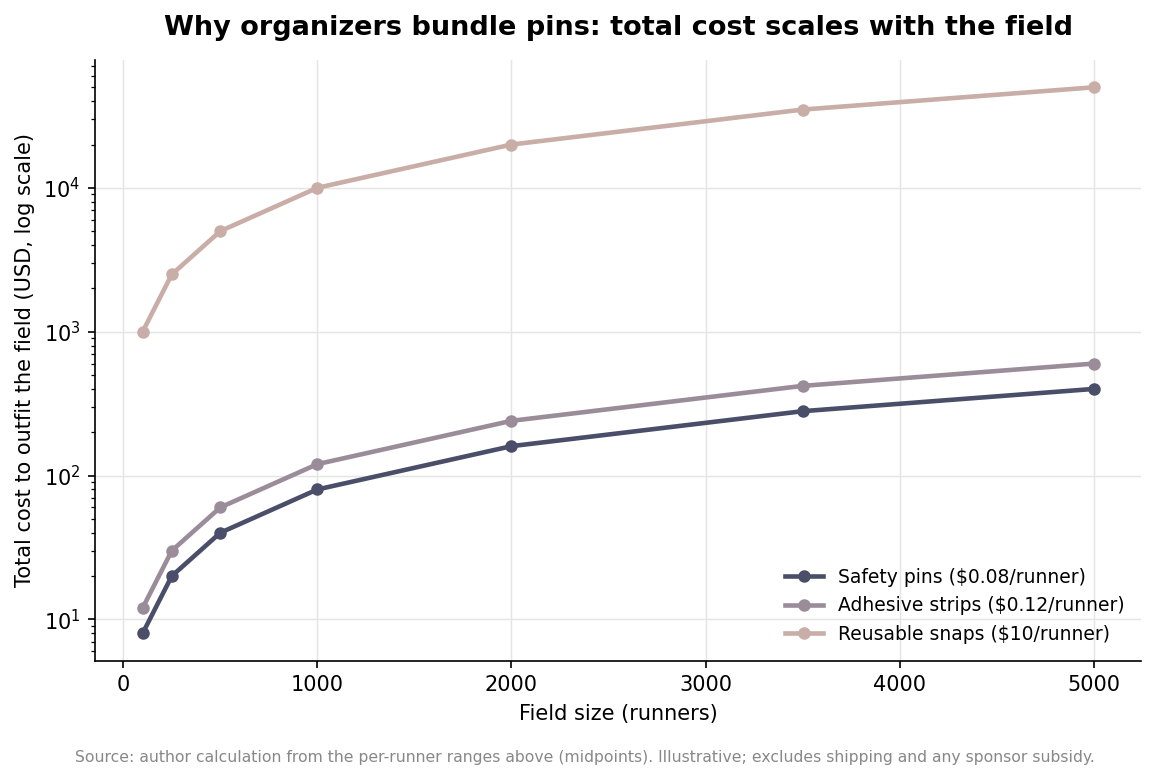
At a 2,000-runner event, pins run on the order of a couple hundred dollars, adhesive strips a little more, and supplying reusable snaps to everyone would cost as much as a mid-size sponsorship. That is the whole argument in one picture: attachment hardware that makes sense as a personal purchase becomes untenable as a giveaway the moment the field grows. This is also why branded reusable holders show up as sponsor-funded premiums or VIP swag rather than standard inclusions; a sponsor may happily underwrite a few hundred logo’d snap sets for elites and pace teams while every other runner gets pins.
Getting attachment right for your event
Match the method to the event rather than defaulting blindly. For a windy point-to-point or a trail race on paper bibs, emphasize four pins and consider upgrading the bib stock to Tyvek so the holes do not propagate. For a chip-timed road race, keep pins but design the bib so the corners are obvious pin zones and the chip area is clearly off-limits, and say so on the packet insert. For a triathlon or multisport event where the number must move from back to front, plan around bib belts and specify a bib with reinforced belt holes or a toggle-friendly layout. And if a sponsor wants a branded attachment moment, route that toward a limited run of snaps or magnets for a subset of participants instead of trying to equip the whole field.
The through-line is that attachment is not an afterthought to slot in the week before the race; it is a spec that should be decided alongside the bib material and timing system. Get it right and no one notices, which is exactly the goal. Costs for pins, strips, and reusable hardware move with supplier and quantity, so confirm current bulk pricing and lead times in writing when you place the bib order, and fold the attachment count into the same purchase so it arrives together.
Leave a Reply