Most race bib ordering mistakes happen before printing: an unfinished number range, an unchecked name list, crowded sponsor logos or the wrong material for the course. Customized Race Bibs returns a free mockup within 24 hours with unlimited free revisions, so every one of these can be caught at the proof stage, before race bibs reach your runners.
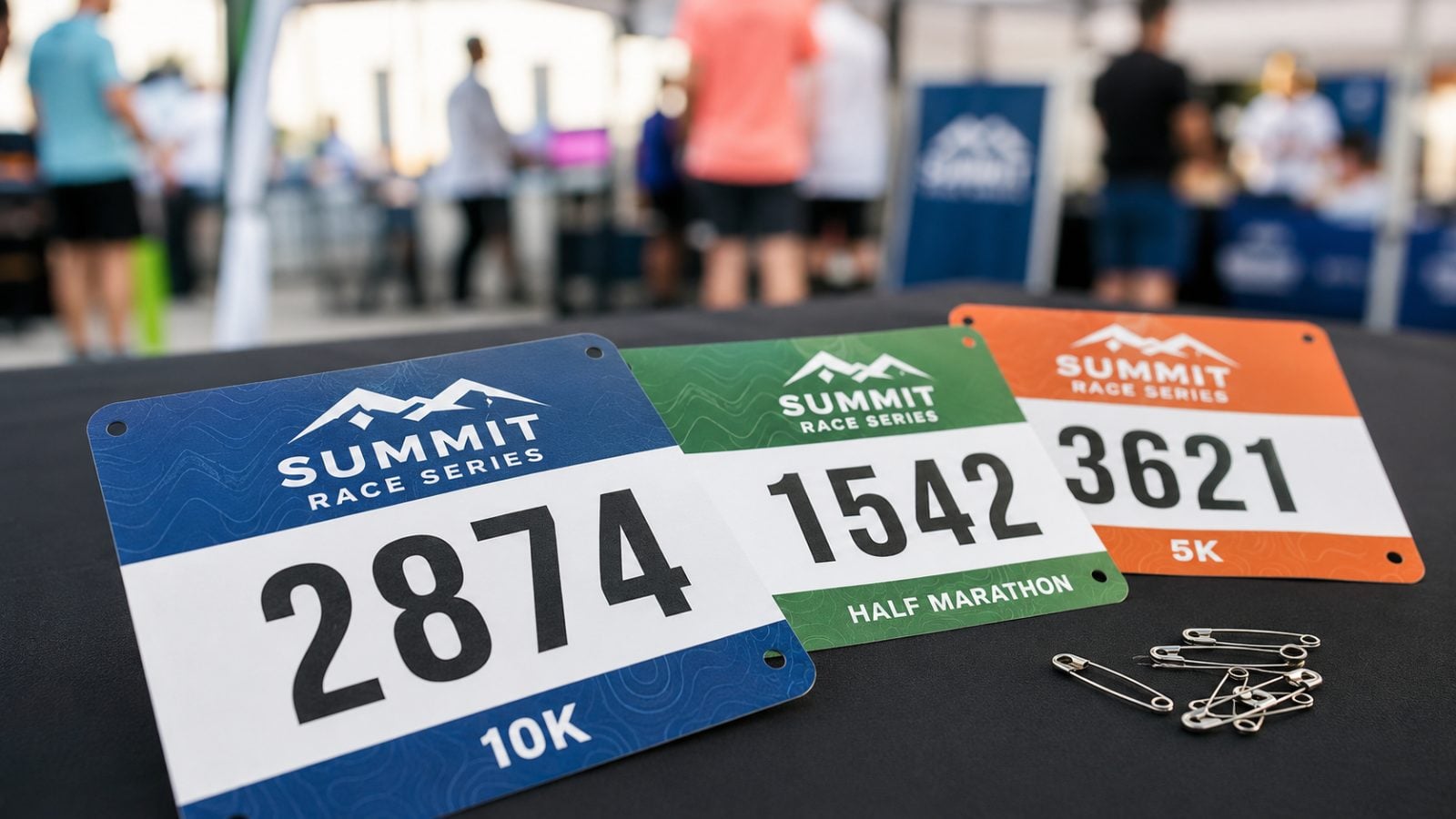
- Free digital mockup returned within 24 hours
- Unlimited free revisions, nothing to pay until you approve the design
- Standard turnaround is about 2 weeks after proof approval
- Minimum order is 12 race bibs
- Faster turnaround is available with express shipping
What are the most common mistakes on a first custom race bib order?
The most common mistakes on a first custom race bib order are an unfinished number range, a misspelled name list, too many sponsor logos and the wrong material for the weather. None of them come from the printing itself. They come from decisions that were still open when the proof was approved, and race bibs are hard to fix once they are packed into runner packets.
First-time race directors usually treat the bib as a small line item next to the course, the permit and the timing company. That is understandable, but the race bib is the one printed piece every runner wears, every volunteer reads and every finish-line photo captures. A small error repeats hundreds of times.
The good news is that each of these mistakes has a simple check. Customized Race Bibs returns a free mockup within 24 hours and offers unlimited free revisions, so the proof stage is the cheapest place to catch problems. The sections below walk through what goes wrong, why it happens and the exact check that prevents it before anything prints.
Why does an unfinished number range cause so many race bib problems?
An unfinished number range causes race bib problems because every other decision depends on it: how many bibs print, which colors map to which distance, how the tear-off tabs are numbered and what the timing company loads into its system. When the range changes after approval, the whole run has to be checked again.
The typical version of this mistake is a race that adds a second distance or a youth division late. The original range was one continuous block, and now the new division either borrows numbers from the middle or starts somewhere that collides with existing registrations. Volunteers at packet pickup then hand out bibs that do not match the roster.
- Give each distance or division its own block of numbers before you request a mockup.
- Leave a clearly reserved block of spare numbers for late entries and replacements.
- Write the range on the quote request so the proof shows the first and last number of every block.
- Share the final range with your timing company the same day you share it with the printer.
A tidy range also makes sorting faster when the boxes arrive, because each block can be counted and bagged on its own.
How do name and spelling errors end up on printed race bibs?
Name and spelling errors end up on printed race bibs when the personalization list is exported straight from registration software without anyone reading it. Race bibs with runner names print exactly what the spreadsheet says, including typos, all-caps entries, nicknames typed into the wrong field and accented letters that were stripped during export.
Runners notice their own name instantly, and a wrong name on a race bib feels personal in a way a wrong number does not. It also shows up in every finish-line photo they share afterward.
- Export the list once registration closes for personalized bibs, not before.
- Sort by last name and scan for duplicates, blank cells and obvious typos.
- Decide on one style: first name only, full name, or name plus team, and apply it to every row.
- Check that long names fit the name line on the mockup without shrinking to an unreadable size.
- Ask the vendor to flag any row that looks unusual before printing.
For runners who register after the personalized list closes, plan on blank-name bibs from your spare block rather than reopening the print file. Customized Race Bibs can print names and sequential numbers together, so a clean list is the only thing standing between you and a perfect run.
Can too many sponsor logos ruin a race bib design?
Yes, too many sponsor logos can ruin a race bib design, because the number is the only element that has to be read from a distance and every extra logo competes with it. A race bib crowded with marks makes the number smaller, the photos busier and every sponsor less visible than a cleaner layout would.
This mistake usually starts with good intentions: each sponsor was promised placement, and the bib feels like the fairest place to deliver it. The result is a strip of small logos across the top and bottom, a squeezed number, and timing or volunteer staff who cannot confirm a runner at a glance.
| Approach | What happens on the bib | Better choice |
|---|---|---|
| Every sponsor on the front | Number shrinks, logos become unreadable | One title sponsor on the front, others on the back or tear-off tabs |
| Full-color logos on a colored background | Low contrast, logos blur in photos | Light background with a single accent color per distance |
| Logos added after approval | New proof, new sign-off, delayed schedule | Lock the sponsor list before requesting the mockup |
Tell sponsors early that the race bib carries one featured partner and that others appear on signage, shirts and the event page. Most accept it once they see the mockup.
Which race bib material mistakes show up on race day?
The race bib material mistakes that show up on race day are paper bibs on a wet or humid course, standard bibs on events where runners pin and repin, and disposable bibs for a series that wanted something reusable. Material is chosen on a quiet desk weeks earlier, but it is tested in rain, sweat and a crowded start corral.
Paper race bibs can work well for short, dry events and school meets. On a long course, a trail run or any race with a real chance of rain, paper softens, the pin corners tear and the number smears where the runner’s hand rubs it. The fix is matching the material to the conditions, not to habit.
- Choose a Tyvek waterproof bib for long distances, wet climates, obstacle events and triathlons.
- Choose a reusable fabric race bib for a club series or a season-long challenge.
- Choose a standard tear-tab race bib when you need gear-check and post-race tabs.
If you are unsure, describe the course and the forecast on your quote request. Customized Race Bibs will suggest a material in the mockup notes, and you can compare options before approving.
What goes wrong when race bib layouts ignore timing chips and safety pins?
Race bib layouts that ignore timing chips and safety pins put logos, names or numbers exactly where the chip sits or where the pins punch through. The bib looks fine on screen, but on the runner a pin covers the first digit or the chip on the back crumples the sponsor mark on the front.
This mistake happens because the mockup is reviewed as a flat graphic. Real race bibs are pinned at the corners, curved over a torso and often carry a chip that the timing company needs in a particular spot. A design that fills the whole surface leaves no room for any of that.
- Keep the four corners free of text so pins never cover the number or a name.
- Ask your timing company where the chip goes, then keep that zone clear on the back.
- Use a timing-chip compatible bib when the event uses chip timing, rather than taping a chip to a standard bib.
- Leave space on the back for emergency contact details and medical notes.
When you review the proof, print it at actual size, pin it to a shirt and look at it from across the room. That single check catches more race bib layout errors than any amount of zooming in on a screen.
Why do race bib orders get rushed, and how do you avoid it?
Race bib orders get rushed because approvals stall, not because production is slow. Customized Race Bibs ships standard orders in about 2 weeks after proof approval, with faster turnaround available through express shipping, yet first-time buyers often lose more time waiting on a sponsor, a board member or a final registration count than the printing takes.
The rushed order brings its own mistakes: skipped proof checks, a guessed number range and no spares. Each of those turns into a problem at packet pickup, which is the worst possible moment to discover it.
- Name one person who signs off on the race bib proof and give them a deadline.
- Collect sponsor logos as vector files before the mockup request, not during revisions.
- Order your main run once the range is final, then use the spare block for late entries.
- Count backward from the day volunteers stuff packets, not from race morning.
The minimum order is 12 race bibs, so a small top-up later is possible if you truly run short. Still, planning the main order properly is calmer than relying on a second shipment arriving in time.
What should a first-time buyer check before approving a race bib proof?
Before approving a race bib proof, a first-time buyer should check the number range, the name list, sponsor placement, material, timing-chip zone and the delivery date against packet pickup. Approval is the last free moment to change anything, and Customized Race Bibs charges nothing until you approve the design.
Use this short checklist with whoever signs off. Read it aloud on a call if several people are involved, so nobody assumes someone else looked.
| Check | What to confirm |
|---|---|
| Numbers | First and last number of every block, spares reserved, tear-off tabs match |
| Names | Spelling, style and fit on the name line |
| Sponsors | Correct versions of every logo, title sponsor placement agreed |
| Material | Suited to weather, distance and whether bibs are reused |
| Back of bib | Chip zone clear, emergency contact space included |
| Timing | Delivery lands before packet stuffing, not before race day |
If any row is uncertain, ask for another revision instead of approving. Revisions are unlimited and free, and one more round now is far cheaper than reprinting race bibs later. When everything checks out, request your quote and lock the schedule.
Frequently asked questions
What is the most common mistake on a first custom race bib order?
The most common mistake on a first custom race bib order is approving the proof before the number range is final. When a distance or division is added later, numbers collide and tear-off tabs stop matching the roster. Customized Race Bibs recommends giving every distance its own block of numbers, plus a reserved spare block, before you request the free mockup.
Can a misspelled runner name be fixed after race bibs are printed?
A misspelled runner name on a printed race bib usually cannot be corrected in place, so the practical fix is a replacement bib from your spare block, either blank or reprinted with the right spelling. The better approach is scanning the name list for typos, duplicates and blank cells before approval, because personalization prints exactly what the spreadsheet contains.
Why do too many sponsor logos hurt a race bib?
Too many sponsor logos hurt a race bib because the number has to be readable from a distance, and every extra mark shrinks it. Crowded race bibs also make each sponsor less visible in photos. A cleaner layout places one title sponsor on the front and moves other partners to the back, the tear-off tabs or event signage.
What happens if race bibs are the wrong material for a rainy course?
Paper race bibs on a rainy course tend to soften, tear at the pin corners and smudge where runners touch them, which makes numbers hard to read at the finish. For wet weather, long distances or triathlons, a Tyvek waterproof bib from Customized Race Bibs holds its shape and keeps the print legible through the whole event.
How should a race director check a race bib proof line by line?
A race director should check a race bib proof by confirming the first and last number of each block, the spelling style for names, every sponsor logo version, the material, the clear zone for the timing chip and the delivery date. Printing the proof at actual size and pinning it to a shirt reveals layout problems a screen hides.
Should each distance at a multi-race event get a different race bib color?
Giving each distance its own race bib color is a simple way to help volunteers, course marshals and timing staff tell runners apart at a glance. Pair each color with its own number block so corrals and results stay clean. Customized Race Bibs can show every color variation in one mockup, so the full set is approved together.
Why do race bibs sometimes tear at the safety-pin corners?
Race bibs tear at the safety-pin corners when a lightweight paper stock meets sweat, rain or runners who pin and repin during a long event. Choosing a tear-resistant material solves most of it, and keeping the corners free of printed text means a torn hole never removes part of the number. Supplying enough pins per runner helps too.
What should be printed on the back of a race bib?
The back of a race bib is the right place for emergency contact lines, a space for medical notes and any secondary sponsor marks. If the event uses chip timing, the chip zone on the back must stay clear. Customized Race Bibs can show the back layout on the same mockup so both sides are approved together.
Do tear-off tabs on race bibs need their own printed numbers?
Tear-off tabs on race bibs should carry the same number as the main bib so gear check, post-race food or a drink ticket can be matched to the runner. A standard tear-tab race bib from Customized Race Bibs can carry the matching number on each tab, which removes one more source of mix-ups at busy volunteer tables.
Can youth runners wear the same race bib size as adults?
Youth runners can wear an adult race bib, but a full-size bib often covers most of a small runner's torso and is awkward to pin. A dedicated youth race bib is sized for children's events and fun runs, keeps the number readable and looks intentional in family photos, which matters for school and community races with a kids' division.
Why does race bib number size matter for finish-line volunteers?
Race bib number size matters because finish-line volunteers, timing staff and photographers need to read the number at a distance while runners are moving. A number squeezed by logos or decorative fonts slows results and causes misidentified photos. A bold, high-contrast number with clear space around it is the single most important element on any race bib.
Get a free mockup for your race bibs
Send your logo or idea and the quantity you have in mind. Customized Race Bibs returns a free mockup within 24 hours, you approve the design before anything is produced, and standard turnaround is about two weeks with faster options available. Get a custom quote.