Author: George

  • Custom Race Bibs: 2026 Pricing, MOQs & Lead Times

    If you’re ordering custom race bibs for a 5K, marathon, or trail series, the first two questions on your mind are probably the same ones every race director asks: what will this actually cost, and how many do I have to buy? The honest answer is that both numbers move a lot depending on material, print sides, and who you order from — minimums range from a single bib to a hundred-piece batch, and per-bib pricing can swing by more than double based on whether you’re printing one side or two.

    This guide pulls together real pricing tiers, minimum order quantities, and turnaround times from working race-bib suppliers so you can budget accurately before you request a quote. It also covers the material call — Tyvek versus cardstock — that trips up a lot of first-time race directors, plus what your printer needs from you to avoid a second proofing round.

    How much do custom race bibs cost?

    Price per bib depends on three things: whether the bib is plain or custom-printed, how many colors and sides are involved, and total order volume. A plain single-sided bib with no custom artwork runs on the low end of the range, while a full-color custom design with printing on both sides sits at the top.

    The gap between single- and double-sided printing is smaller than most first-time buyers expect — roughly $0.10 per bib — so if you’re planning to put sponsor logos or a course map on the back, it’s rarely worth cutting for cost reasons alone. Volume also matters: most printers apply per-unit discounts as order size climbs past a few hundred bibs, though exact break points vary by vendor and aren’t published as a flat rate card.

    Full-color custom printing costs roughly double a plain bib, and printing the back adds about $0.10 more per bib.
    Bib Type Price Per Bib
    Plain single-sided (no custom art) $0.15 – $0.25
    Custom single-sided (full-color) $0.20 – $0.40
    Custom double-sided $0.30 – $0.50
    Full-color custom printing costs roughly double a plain bib, and printing the back adds about $0.10 more per bib.Source: Race Bibs: A Buyer’s Guide, RaceDirectorsHQ (racedirectorshq.com/read/race-bibs-guide-18)

    Minimum order quantities and lead times

    Minimum order quantities are where suppliers diverge the most, and it’s worth shopping around if you’re running a small event. Some printers cater specifically to bulk marathon orders and won’t quote under 100 units, while others will print a single custom race bib for a birthday 5K or a family fun run.

    Turnaround time follows a similar split. A supplier with a low minimum and quick proofing is often the better fit for a small local race, while a bulk-focused printer may offer better per-unit pricing once you’re ordering in the hundreds but needs more lead time to slot your job into production.

    Minimum orders range from a single bib to 100, so smaller races don’t have to over-order just to get custom printing.
    Vendor Minimum Order Notes
    BlackStrap 24 bibs USA-made; artwork proof in 2–3 business days
    Custom Race Bibs No minimum Single custom bib available from $12.95
    LacedUp Places 100 bibs Bulk pricing applies at this volume
    Boulder Bibs No stated minimum 15 business days minimum turnaround from in-hand date
    Minimum orders range from a single bib to 100, so smaller races don’t have to over-order just to get custom printing.Source: Vendor websites: blackstrap.com/pages/custom-race-bibs, customracebibs.com/?page_id=11, laceduplaces.com/pages/custom-race-bibs, boulderbibs.com/pages/faq (accessed August 2026)

    Tyvek vs. cardstock: which material should you choose

    Material is the single biggest factor in both cost and durability, and it’s worth deciding early since it affects your quote request.

    Tyvek

    Tyvek is a spun-bonded polyethylene material — waterproof, tear-resistant, and able to survive rain, mud, and heavy sweat without falling apart on the runner’s chest. It’s the standard choice for anything longer than a half marathon, trail races, mud runs, and multi-sport events where the bib takes real physical punishment. The tradeoff is cost: Tyvek runs roughly 10–20% more than an equivalent cardstock bib.

    Cardstock

    Cardstock (sometimes called standard or paper stock) is cheaper and prints with slightly crisper color detail, but it’s not built for wet or high-exertion conditions. It’s a reasonable choice for kids’ fun runs, short indoor events, or races where the bib is more of a keepsake than functional gear worn for hours in variable weather.

    Bib sizes, perforations, and timing chip placement

    Most race bibs measure between 6 and 8 inches wide by 4 to 6 inches tall, with roughly 7″x5″ being the most common footprint across printers. Custom sizing is available from most suppliers, but sticking close to standard dimensions keeps your bib compatible with off-the-shelf bib belts and pin-friendly corner spacing.

    If you’re using a tear-off tab — for a raffle entry, drop-bag claim, or post-race meal voucher — specify the perforation type when you request your quote: no perforation, single tear-off, double tear-off, or a multi-perf layout for several detachable sections. Each of these needs to be built into the print file, not added after the fact.

    For timed events, confirm your timing chip vendor before you finalize bib design. RFID chips are typically applied to the back of the bib in a location that lets bibs nest and stack flat for shipping, and placement can vary by timing system — ChronoTrack, RaceResult, RM Timing, and MYLAPS are the most common brands your printer will ask about.

    How far in advance to order your bibs

    Lead time expectations break down into a few rough tiers. Ordering 4 to 6 weeks before your event is the ideal window — it leaves room for artwork revisions, a physical proof if you want one, and any last-minute participant count changes. A 2 to 4 week window is still workable and considered normal for most printers, but you’ll want your artwork close to final before you submit.

    Inside 10 days out, you’re in crunch territory: expect fewer revision rounds and possibly a rush fee. Under 5 days before the event is what one industry supplier bluntly calls panic mode — not every printer will take the job, and the ones that do will charge for it. Artwork proofs themselves usually turn around fast once files are submitted — commonly within 48 hours to 3 business days — so the bottleneck is almost always production and shipping time, not design review.

    What to send your printer for a clean proof

    A clean first proof saves a revision cycle, which matters most when you’re ordering close to your event date. Send vector artwork (AI, EPS, or high-resolution PDF) rather than a low-res logo pulled from a website, and specify your Pantone or CMYK colors rather than leaving color matching to guesswork.

    Include your numbering sequence and format — whether bibs need to start at a specific number, skip reserved ranges for elite or wheelchair athletes, or include age-group prefixes — along with any variable data like runner names. Confirm sponsor logo placement, perforation lines, and chip location on the same proof round rather than adding them after approval, since each of those can shift the print layout.

    Frequently asked questions

    What is the minimum order for custom race bibs?

    It depends on the printer. BlackStrap’s minimum is 24 bibs, LacedUp Places requires 100 for bulk pricing, and some printers — including Custom Race Bibs — will produce a single custom bib starting around $12.95. If you’re running a small event, ask about single- or low-quantity options before assuming you need to hit a bulk minimum.

    How much do custom race bibs cost per unit?

    Plain single-sided bibs typically run $0.15–$0.25 each. Custom full-color single-sided printing runs $0.20–$0.40, and double-sided custom printing adds about $0.10 more, landing around $0.30–$0.50 per bib. Volume discounts usually kick in on larger orders, though exact break points vary by vendor.

    Should I choose Tyvek or cardstock for my race bibs?

    Choose Tyvek for anything longer than a half marathon, trail races, or events with rain, mud, or heavy sweat exposure — it’s waterproof and tear-resistant. Cardstock is fine for short fun runs or kids’ races where the bib won’t face hours of physical wear, and it costs roughly 10–20% less than Tyvek.

    How far in advance should I order custom race bibs?

    Order 4–6 weeks before your event for the smoothest process. A 2–4 week window is still normal for most printers. Under 10 days out is considered rush territory with fewer revision rounds and possible rush fees, and under 5 days is often too late for some suppliers to take the job at all.

    Can custom race bibs be used with timing chips?

    Yes. RFID timing chips are applied to the back of the bib in a spot that lets finished bibs nest and stack flat for shipping. Confirm your timing vendor — ChronoTrack, RaceResult, RM Timing, and MYLAPS are the most common — before finalizing your bib design, since chip placement can affect layout.

    What file format should I send for race bib printing?

    Send vector artwork — AI, EPS, or a high-resolution PDF — rather than a web logo, and specify exact Pantone or CMYK colors. Include your numbering sequence, any reserved number ranges, sponsor logo placement, and perforation requirements in the same submission to avoid an extra proofing round.

    The bottom line

    Pin down your material and quantity first — Tyvek versus cardstock and your expected headcount will narrow your vendor list faster than anything else. From there, match your order to a printer whose minimum and turnaround actually fit your race: a small local event is often better served by a low-minimum shop with a fast proof cycle than a bulk printer built for thousand-bib marathons.

    Get your quote requests out 4–6 weeks before you need bibs in hand, send vector artwork with your numbering sequence and chip vendor specified up front, and you’ll avoid the rush fees and compressed revision rounds that come with ordering custom race bibs at the last minute.
  • RFID Timing Bibs, Explained: How the Chip on the Back Actually Works

    RFID Timing Bibs, Explained: How the Chip on the Back Actually Works

    Flip over a modern race bib and you will usually find a thin foam-and-film rectangle glued to the back. That is the timing tag, and it is the reason a 3,000-person race can post accurate finish times within seconds of each runner crossing the line. For a race director choosing bibs, understanding what that tag is and how it gets read changes the questions you ask your printer and your timer. This is a plain-language walk through the technology and the numbers behind it.

    What the tag on the back actually is

    The overwhelming majority of race timing runs on passive UHF RFID operating in the 860 to 960 MHz band, following the ISO/IEC 18000-6C and EPC Gen2v2 standards. Passive means the tag carries no battery. It sits inert until it enters the radio field thrown out by a reader antenna, draws power from that field, and reflects back a modulated signal carrying its unique ID. That is why disposable tags can cost cents rather than dollars: there is nothing inside but an antenna and a tiny chip.

    The physical tag is a printed inlay, typically something like an Impinj M830 or NXP UCODE 9 in a 97 by 27 millimeter label, with the antenna trace occupying most of that footprint. It is adhered to the bib during production, oriented to match the polarization of the timing antennas the race will use. One detail matters more than people expect: the human body absorbs UHF radio energy, so tags are often mounted with a small foam spacer that lifts the inlay a few millimeters off the runner’s shirt. That gap measurably improves read rate. This is also why the tag lives on the bib, worn on the front of the torso facing the antennas, rather than tucked into a pocket.

    How your time gets recorded

    At each timing point the runner passes through a reading field created by antennas. Two antenna styles do the work. Mat antennas lie flat on the ground and read tags from below as runners step over them, while panel antennas stand on both sides of the course at roughly bib height, angled inward. Large races combine the two so a tag gets multiple chances to be read from multiple angles in the fraction of a second a runner is in the zone. The reader logs the tag ID and a timestamp, and software matches that ID to the runner assigned to the bib.

    Read rate is the number that keeps timers awake. A well-designed system is expected to catch essentially everyone: as a reference point, the New York City Marathon has reported a 99.9 percent read rate using roughly 70 controllers across 30 control lines. That reliability does not come from one antenna working harder; it comes from redundancy, both in antenna placement and, often, in the number of tags on each bib.

    One tag or two?

    Timers talk about single versus double bib tagging. In a single-tag setup each bib carries one inlay, which is the most cost-effective choice and is perfectly adequate for most local and mid-sized events. In a double-tag setup, two inlays encoded with the same ID are applied to each bib, separated by at least a few inches so they do not detune each other. Because either tag can trigger the read, the odds of missing a runner drop sharply, which is why championship and large-field races often specify it. The tradeoff is blunt: two tags cost roughly twice as much per bib as one.

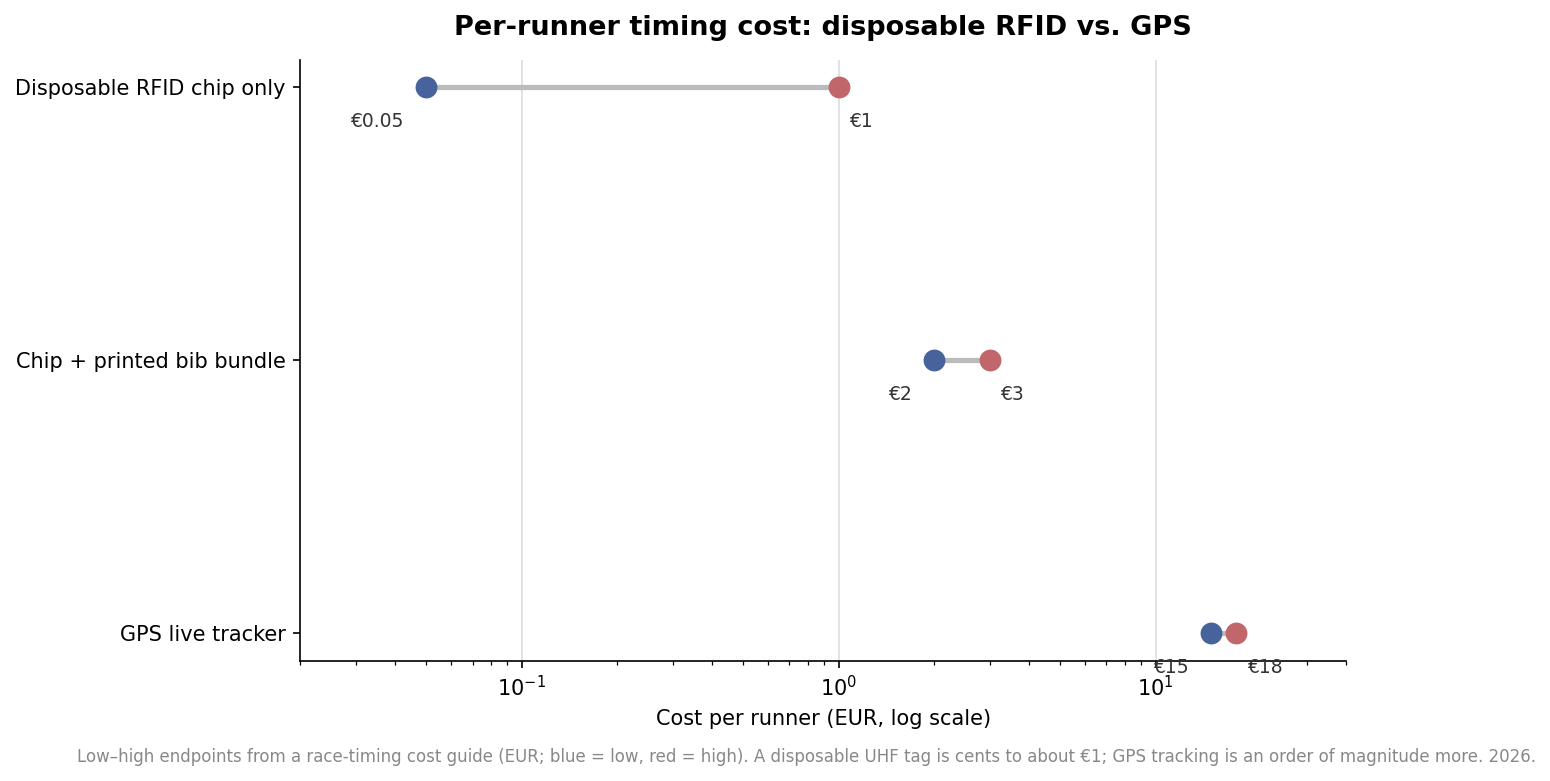
    That decision is really about per-runner economics, and the numbers are small but they scale. A disposable UHF inlay runs from a few cents to about one euro depending on volume and model, so a bundled chip-and-bib package typically lands around two to three per participant. Double-tagging pushes the tag portion up before you have printed a single number. Across a 5,000-runner event, choosing double tags is a four-figure line item, so it is worth deciding deliberately rather than by default.

    Dumbbell chart comparing per-runner timing cost in euros: disposable RFID chip, chip plus bib bundle, and GPS tracker on a log scale
    Per-runner cost by method: disposable RFID timing is an order of magnitude cheaper than GPS.

    Read the chart as orders of magnitude rather than exact quotes. The takeaway for most organizers is that disposable RFID is the cheapest reliable way to time a field, an order of magnitude below live GPS tracking, which is why it dominates road racing. Reserve GPS for events where spectators need a moving map, not for standard finish-line timing.

    What the full timing setup costs

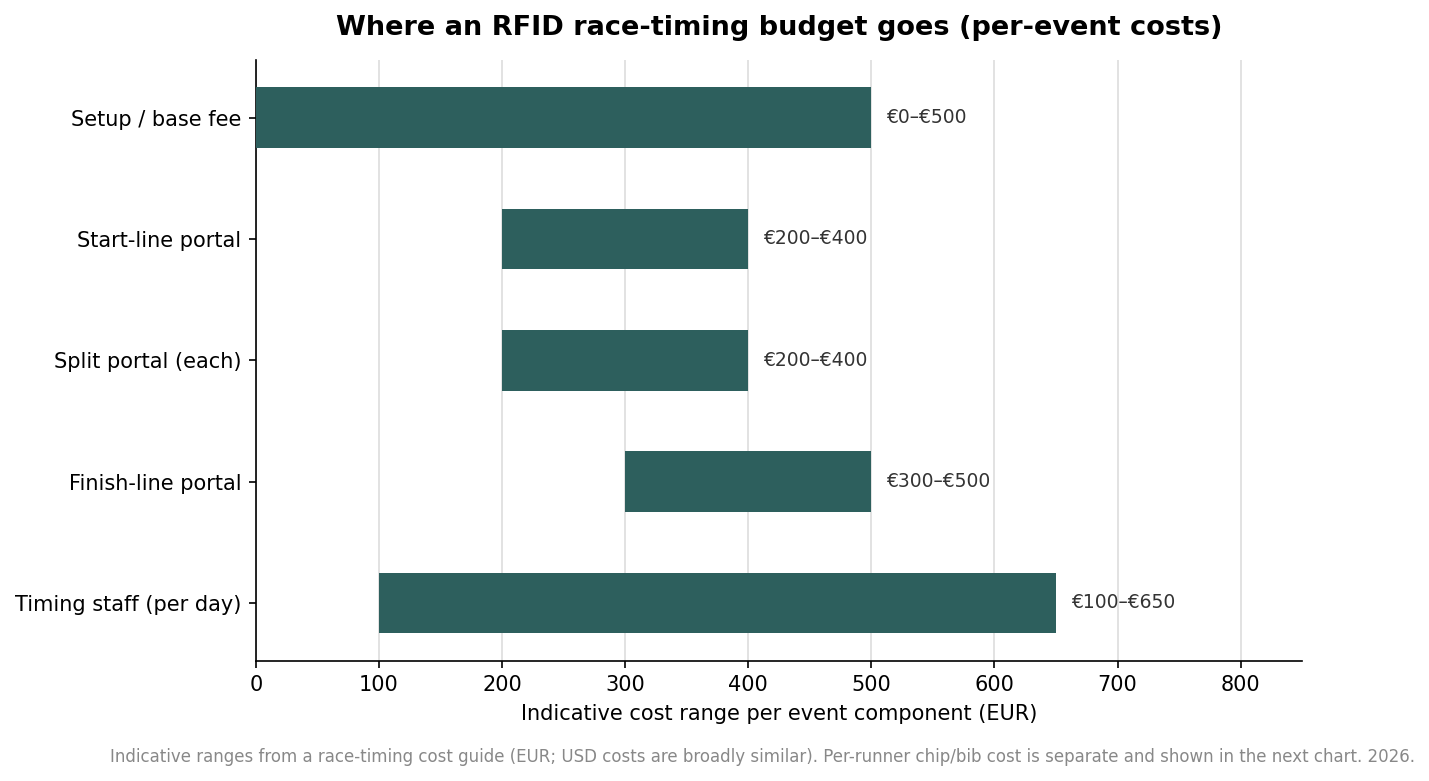
    The tag is the cheap part. The larger costs sit in the timing operation around it: the portals at the start, finish and any split points, the mats and structures, and the staff who run them on race day. A small local race can be timed for a few hundred, while a large event with multiple splits and backup systems runs into the thousands.

    Floating bar chart of per-event RFID race timing cost ranges in euros for setup, start, split and finish portals and daily timing staff
    Indicative per-event cost ranges for an RFID timing setup; the tag itself is the cheap part.

    These are indicative euro ranges from a timing-cost guide, and dollar figures are broadly similar, but the structure is what to internalize. Fixed costs like portals and staff do not shrink with a small field, so per-runner cost is high for tiny races and falls as you spread those fixed costs across more entrants. If you are timing a 200-person fun run, the chips are almost free and the portals are almost everything; at 5,000 runners the balance flips. Knowing which side of that curve you are on tells you whether to negotiate the setup fee or the per-tag price.

    What to hand your timer and your printer

    Two suppliers touch the bib: whoever prints it and whoever times the race, and they need to agree before production. Ask your timer which tag model and orientation they want, whether they need single or double tagging, and whether they supply the inlays or expect the printer to apply them. Many bib printers can adhere disposable inlays during production, which saves the timer a night of hand-applying stickers, but only if the tag placement and spacing are specified up front. Confirm the tag sits in a consistent zone on every bib, clear of fold lines and pin holes, and leave the foam spacer in the plan if your timer recommends one. Get those details onto the order and the technology mostly disappears into the background, which is exactly where a race director wants it on event morning.

  • Race Bib Template: How to Lay Out a Bib That Reads at the Finish Line

    Race Bib Template: How to Lay Out a Bib That Reads at the Finish Line

    A race bib looks like the simplest print job at an event, a number on a rectangle, until you try to lay one out and discover how many jobs that rectangle has to do at once. It has to be readable from thirty feet by a finish-line camera, survive rain and safety pins for a few hours, carry sponsor logos that paid for the race, hold a timing tag on the back, and give medical staff a runner’s emergency contact if something goes wrong. A good template is what keeps those demands from colliding. Here is how the pieces fit, from the number outward.

    Start with the size, then the number

    Bib dimensions vary by event, but most land in a familiar band. A common all-purpose size sits around 6 by 9 inches, small events and kids’ races drop closer to 5 by 7, and slim competitor-number strips run as narrow as 8 by 3.5 inches. Pick the size first because everything else is a proportion of it. The race number is the single most important element and should dominate the layout; on that 8 by 3.5 inch strip the numerals stand about 2.5 inches tall, and larger marathon bibs push the digits taller still so a camera can read them across a crowded chute. As a working rule, make the number as large as the bib allows after margins, set it in a heavy, condensed typeface, and keep it in solid black on a light field for the highest contrast. Everything that is not the number is secondary and should look it.

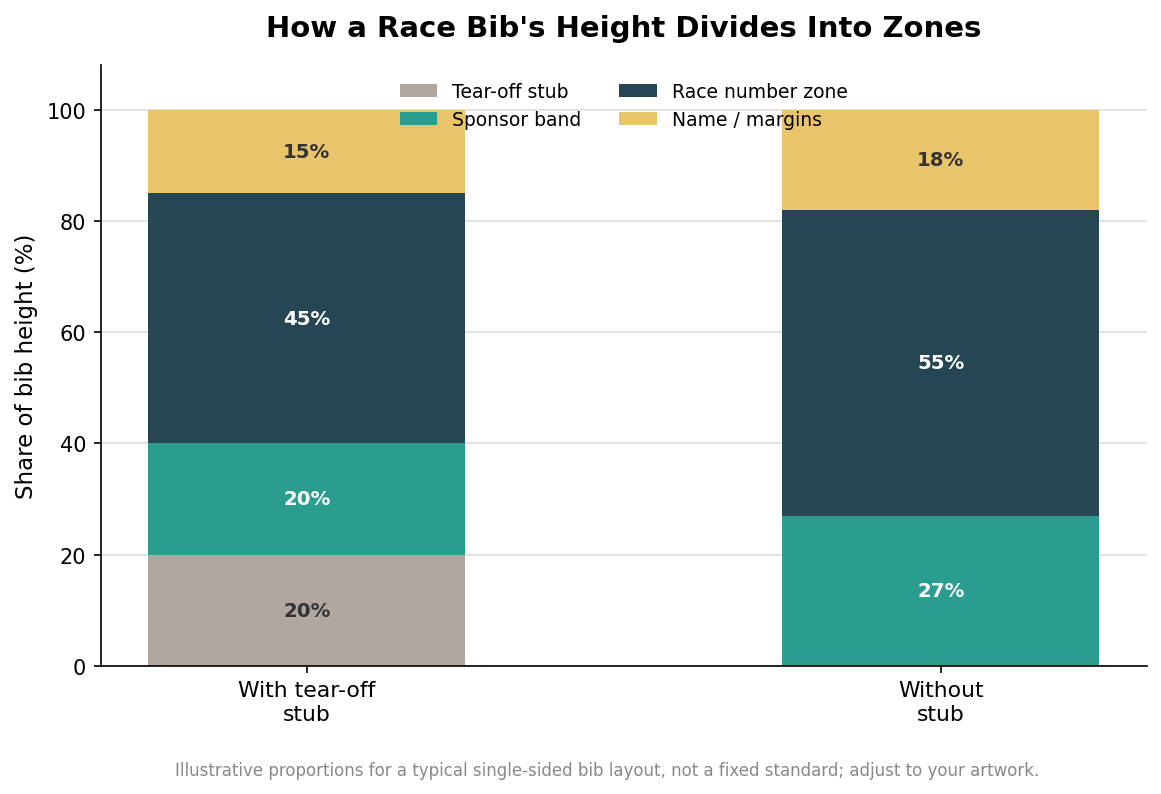
    Stacked vertical bar chart showing how a race bib's height divides into number, sponsor, name, and tear-off stub zones
    An illustrative split of a bib’s height into its functional zones, with and without a tear-off stub.

    The zones on the front

    Think of the front as stacked bands rather than a blank canvas. The number zone takes the center and the majority of the height. A thin name or message line can sit above it for personalized bibs, which lift finish-line energy when a spectator can shout a runner’s name. The sponsor band belongs at the bottom, where logos stay visible without competing with the number, and it is worth reserving that strip early because sponsor artwork always arrives late and in the wrong proportions. If the race uses barcodes or QR codes for check-in or results, they need a quiet corner with clear space around them so a scanner is not fighting a logo. Larger races add one more layer to this band structure: a color block or a printed letter that marks a runner’s start wave or corral, which lets volunteers sort a field of thousands at a glance. Keep that marker bold and near the top or a corner where a marshal can see it without asking the runner to turn around. Resist the urge to fill every gap; white space is what makes the number pop.

    The stub and the corners

    Two functional details decide whether a bib works on the ground. The first is the tear-off stub, a perforated strip usually at the bottom that staff pull for bag check, results reconciliation, or a post-race meal, and it needs its own space with the runner’s number repeated on it so a detached stub is still identifiable. The second is the corners. Bibs are pinned through all four, so keep the number and any vital text inside a safe margin away from the corners and edges, because a pin through a digit or a logo looks careless and can tear. Leaving a clear border of roughly a third to half an inch around the live area also gives the material something to give when it flexes, which matters more on paper than on Tyvek.

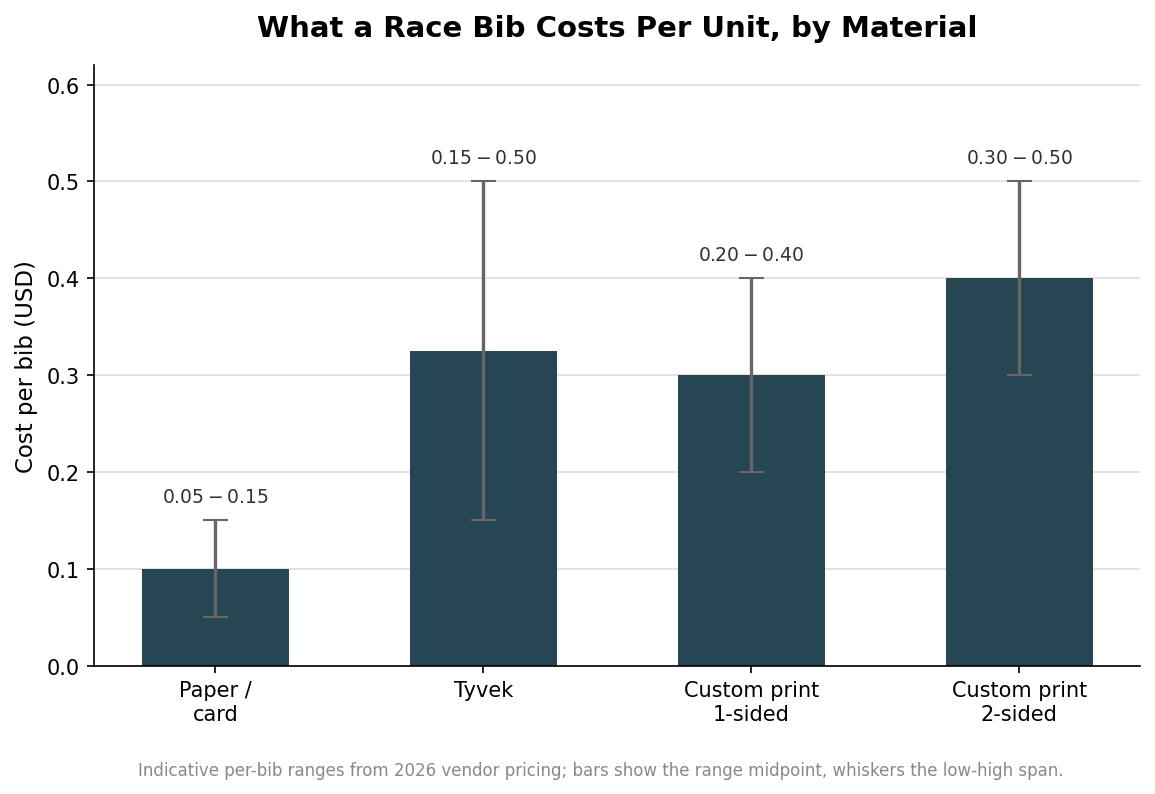
    Bar chart with error bars showing per-bib cost ranges for paper, Tyvek, and single- and double-sided custom-printed race bibs
    Per-bib cost by material; bars mark the range midpoint and whiskers the low-to-high span.

    The back is not blank space

    The reverse of the bib does real work. Most events print an emergency contact and basic medical field on the back for runners to fill in, a small safety feature that medical teams genuinely use. The back is also where the timing tag lives on chip-timed races. Disposable UHF RFID tags are fixed to the back of the bib, mounted on a thin protective foam layer that holds the antenna off the runner’s body and keeps it dry, and they can be applied horizontally or vertically depending on the tag and the timing system. If your race is chip-timed, ask the timer for their tag footprint and keep that area of the back free of heavy ink and folds, because a crease across the antenna is a lost read at the mat. Design the back at the same time as the front, not as an afterthought once the artwork is approved.

    Material, cost, and a clean export

    Material sets both durability and budget, and the spread is wide for such a small item. Plain paper or card bibs run roughly 5 to 15 cents each and suit dry, short, low-stakes events. Tyvek, the tear- and water-resistant synthetic that most serious races use, lands around 15 to 50 cents per bib depending on size and print. Full-color custom printing tends to sit near 20 to 40 cents for a single-sided bib, with roughly another dime per bib to print the back as well, which is money well spent once you are putting emergency fields and a timing tag back there. When you export the template, build it at the final size with a small bleed, keep the number and critical text inside a safe margin, and supply sponsor logos as vector art so they stay crisp at any scale. Lock the size, the number, and the back layout early, and the race bib stops being a last-minute scramble and becomes the reliable, readable rectangle the whole event depends on.

  • How to Choose Custom Race Bibs for Your Brand

    How to Choose Custom Race Bibs for Your Brand

    How to Choose Custom Race Bibs for Your Brand: Use Cases and Ordering

    The best way to choose custom race bibs is to start from how they will be used, then work back to the material, size, and decoration that fit. Custom race bibs serve very different jobs across food service, e-commerce inserts, retail & branding, and events, and matching the order to the job is what makes custom race bibs feel purpose-built rather than generic. This guide maps the common use cases and walks through ordering custom race bibs that fit your brand.

    Whether the race bibs protects a product, presents a gift, or carries a logo into the world, defining that job first keeps every later decision easy. Purpose drives the spec, and the spec drives the result.

    How brands use custom race bibs

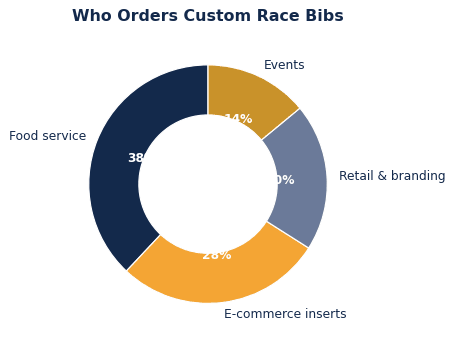
    Custom race bibs get ordered for a mix of protection, presentation, and promotion, and knowing where yours fall points you to the right build. The breakdown below shows the common uses, from food service to events.

    The common ways brands put custom race bibs to work.
    The common ways brands put custom race bibs to work.

    Most orders lean toward one primary job with a secondary benefit — a shipping-focused race bibs that also brands the unboxing, or a gift-focused one that also protects. Naming your primary use keeps the order focused and the spec appropriate.

    Use case What it needs
    Food service branded, food-safe paper that dresses up a serve
    E-commerce inserts thank-you and instruction cards that build loyalty
    Retail & branding labels and wraps that reinforce the brand
    Events printed pieces that tie a theme together

    Matching material and size to the use

    Once the use is clear, the material and size follow. A protection-first job favors a durable, well-fitted build; a presentation-first job favors a premium material and a clean print; a promotion-first job favors a cost-effective option you can order in volume. Sizing to the product with a small margin keeps the race bibs looking intentional and performing its job.

    If a single order serves more than one use, spec to the most demanding one so the race bibs performs everywhere. It is easier to use a slightly sturdier or more premium race bibs across the board than to discover a bargain option falls short for your most important use case.

    Branding for the impression you want

    Decoration should reinforce the impression the use calls for. Digital and offset printing reproduce full-color art crisply, with spot colors and foil available for a premium touch. For a premium or gift use, lean on finishes and restraint; for high-volume promotion, prioritize a bold, legible logo that reads at a glance and reproduces affordably at scale. Keep branding consistent with the rest of your packaging or merch so everything reads as one system.

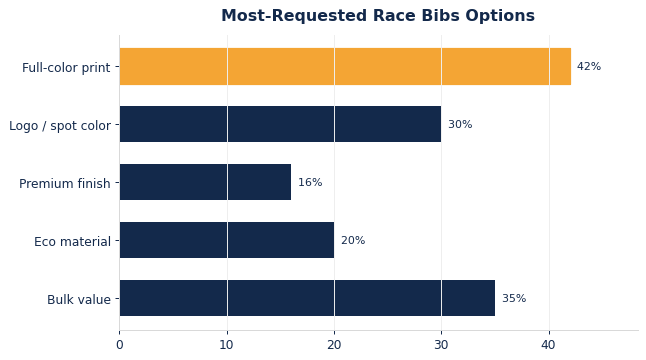
    The most-requested options below reflect what buyers reach for most, and they are a useful starting menu when you brief your order. Whatever you choose, approve a proof so the finished custom race bibs match the impression you intended.

    The options buyers request most on custom race bibs.
    The options buyers request most on custom race bibs.

    Getting the size and details right

    Even with the use and material decided, the details are what make custom race bibs feel finished. Confirm the size and weight against the product with a small margin, check the print area for your chosen size so the logo sits cleanly, and decide on any finishing touches before you brief the order. These small confirmations up front are what separate a race bibs that looks intentional from one that looks close-enough.

    A sample or proof is the cheapest insurance you can buy on a race bibs order. A physical sample lets you judge the material and print in hand, while a digital proof confirms artwork, color, and size and weight before the full run. Spending a few minutes here prevents the far larger cost of reworking a finished order of custom race bibs that missed on a detail.

    Ordering: quantities, lead time, and reorders

    A smooth race bibs order comes down to a few basics: order for real demand plus a small overage, send print-ready artwork early, and confirm lead time against any deadline so production and shipping fit your timeline. Per-unit cost drops with volume, so consolidating a season’s needs into one run is usually more efficient than repeated small orders.

    Keep your approved artwork and spec on file so reorders are a quick repeat rather than a fresh setup each time — consistency across runs keeps your brand looking deliberate.

    Coordinating with the rest of your brand

    Custom race bibs rarely stand alone; they sit alongside your other packaging, print, or merch, so coordinating them strengthens the whole brand. Carrying the same logo, colors, and tone across your race bibs and your other pieces makes everything read as one deliberate system rather than a set of one-off orders. That consistency is what makes a brand feel established, and it costs nothing extra to plan.

    Coordination also simplifies buying over time. Standardizing on a material, size, and decoration you are happy with turns future orders into simple repeats, and it keeps every batch matching the last. A little upfront alignment pays back every time you reorder custom race bibs.

    Frequently asked questions about custom race bibs

    What are custom race bibs used for?

    Custom race bibs serve a mix of protection, presentation, and promotion across food service, e-commerce inserts, retail & branding, and events. Most orders lean toward one primary job with a secondary benefit, so naming your main use is the first step in speccing the right race bibs.

    How do I match custom race bibs to my use?

    Let the use drive the spec: durable and well-fitted for protection, premium and clean for presentation, cost-effective and bold for promotion. If one order serves several uses, spec to the most demanding one so the race bibs performs everywhere.

    How should I brand custom race bibs?

    Digital and offset printing reproduce full-color art crisply, with spot colors and foil available for a premium touch. Choose finishes and restraint for premium or gift uses, and a bold, legible logo for high-volume promotion, keeping the branding consistent with your other packaging or merch so it all reads as one system.

    How far ahead should I order custom race bibs?

    Order for real demand plus a small overage, send print-ready artwork early, and confirm lead time against any deadline so production and shipping fit your timeline. Consolidating a season’s needs into one run is usually more efficient than repeated small orders.

    Can I reorder easily?

    Yes. Keeping your approved artwork and spec on file makes reorders a quick repeat rather than a fresh setup, and it keeps every batch of custom race bibs matching the last for a consistent brand look.

    Do I need a sample before ordering custom race bibs?

    A sample is worth it for a first order or a new material, since judging feel and print in hand removes the guesswork. For a straightforward reorder of custom race bibs you have bought before, a digital proof confirming artwork and size and weight is usually enough.

    Match the race bibs to the job, spec it deliberately, and approve a proof, and your order will do exactly what you needed. For the full material and sizing breakdown, see our companion guide, our Custom Race Bibs: Materials, Sizing & Branding Guide, and browse our our shop to get started.

    Not sure which custom race bibs fit your use?

    Tell us how you’ll use them and we’ll match the material, size, and branding to the job.

    Get a Quote

  • Custom Race Bibs: Materials, Sizing & Branding Guide

    Custom Race Bibs: Materials, Sizing & Branding Guide

    Custom Race Bibs: A Materials, Sizing, and Branding Guide

    Getting custom race bibs right comes down to three decisions: the material, the size or spec, and how you brand them. Make those well and you end up with custom race bibs that protect and present your product, reinforce your brand, and land on budget. This guide walks through the material options, how to size and spec your order, and how to decorate custom race bibs so they do real work for your brand rather than just checking a box.

    Whether you are ordering your first run or reordering at scale, the same fundamentals apply. Choosing custom race bibs deliberately — material to job, size to product, decoration to brand — is what separates an order you are proud of from one you settle for.

    Why custom race bibs matter for your brand

    Custom race bibs are more than a commodity; they are a touchpoint brands experience directly. A well-chosen, well-branded option signals quality and attention to detail, while a generic one quietly undercuts an otherwise strong product. Because custom race bibs are seen and handled, they carry your brand into the world every time they are used.

    That visibility is exactly why it pays to spec custom race bibs intentionally. The material sets the feel, the size sets the fit and cost, and the decoration sets the impression — and getting all three aligned turns a functional item into a genuine brand asset.

    Materials and options compared

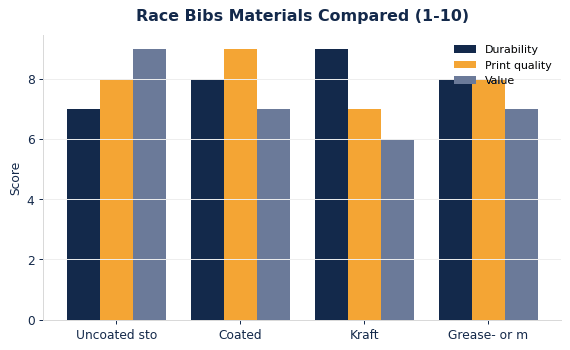
    The common materials for custom race bibs each trade off durability, print quality, and cost: uncoated stock, coated / gloss stock, kraft / recycled, and grease- or moisture-resistant. The right pick depends on how the race bibs will be used, the look you want, and your budget. The chart and table below compare the main options so you can match material to job.

    How common race bibs materials compare on durability, print quality, and value.
    How common race bibs materials compare on durability, print quality, and value.

    As a rule of thumb, choose a recyclable or natural material when eco positioning matters, a coated or laminated option when you want vivid full-color print, and a premium build when the race bibs is part of a gift or high-end presentation. When in doubt, request a sample so you can judge feel and print before committing to a full run.

    Material / option Best for
    Uncoated stock natural, writable surface with a matte look
    Coated / gloss stock vivid color and a polished finish
    Kraft / recycled eco-forward, warm natural tone
    Grease- or moisture-resistant food-safe performance where needed

    Sizing and specs

    Sizing is where many race bibs orders go wrong, so measure before you order. Custom race bibs typically range from a small insert card up to a full wrap or liner sheet, and the right size and weight depends on the product or use they serve. Too small and the fit is tight or the product is exposed; too large and you pay for material you do not need and lose a clean, intentional look.

    When a measurement falls between standard options, size to the product with a small margin rather than guessing. Confirming the size and weight on a proof or sample before a large run prevents the costly mistake of a full order that does not fit, which is far more expensive to fix than a five-minute check up front.

    Branding and decoration

    Decoration is what turns a plain race bibs into a branded one. Digital and offset printing reproduce full-color art crisply, with spot colors and foil available for a premium touch. Match the method to your artwork and budget: simple logos reproduce cleanly and cheaply, while detailed, full-color designs shine with the right process on the right material. Keep the artwork vector where possible and confirm the print area for your chosen size.

    Restraint usually reads as premium. A clean logo, one or two brand colors, and quality material almost always look more considered than a busy, over-printed design. Approving a proof before the run protects both the look and the budget, especially on a large order of custom race bibs.

    Ordering and budget

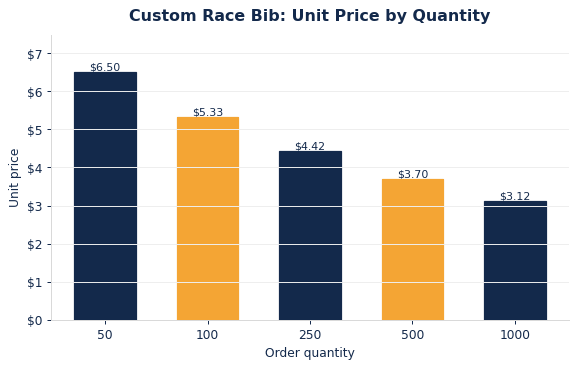
    Per-unit cost on custom race bibs falls steadily with volume as setup amortizes across more pieces, so ordering for real demand rather than a token first batch is usually the efficient move. The curve below shows how pricing typically improves with quantity, which helps you plan an order that balances cash and cost.

    Typical per-unit race bibs pricing as order quantity increases.
    Typical per-unit race bibs pricing as order quantity increases.
    Ordering for a recurring need? A single larger run lowers the unit cost and keeps your branding consistent, while a small overage covers reorders and the occasional damaged piece without a rush order.

    Common mistakes to avoid

    A few avoidable missteps account for most disappointing race bibs orders. Ordering before measuring is the biggest, followed by choosing a material for price alone without considering how the race bibs will actually be used, and skipping the proof on a large run. Each is easy to prevent with a few minutes of planning, and each is expensive to fix once a full order is produced.

    The other common trap is over-designing the artwork. Cramming in too many colors, effects, or details can muddy the print and raise the cost, especially on textured or recycled materials. Simplifying the design to a clean, legible mark almost always improves both the look and the price of your custom race bibs.

    Frequently asked questions about custom race bibs

    What material is best for custom race bibs?

    It depends on the use: choose a recyclable or natural material for eco positioning, a coated or laminated option for vivid full-color print, and a premium build for gifting or high-end presentation. Request a sample to judge feel and print before a full run of custom race bibs.

    How do I choose the right size?

    Measure the product or use the race bibs serves, then size to it with a small margin so the fit is clean without wasting material. When a measurement falls between standard options, size up slightly and confirm the size and weight on a proof before ordering in volume.

    How are custom race bibs branded?

    Digital and offset printing reproduce full-color art crisply, with spot colors and foil available for a premium touch. Match the method to your artwork and budget, keep the art vector where possible, confirm the print area for your size, and approve a proof so the finished custom race bibs match your intent.

    How does pricing work, and is there a minimum?

    Per-unit cost drops with quantity as setup amortizes across the run, so larger orders are more cost-effective. Order for real demand plus a small overage rather than a token batch, and consolidate recurring needs into one run for the best price.

    Can I get a sample or proof before ordering?

    Yes, and it is strongly recommended. A physical sample lets you judge material and print, and a digital or physical proof confirms your artwork, color, and size and weight before a full run — a small step that prevents a costly mistake on a large order.

    What do you need to quote custom race bibs?

    To quote accurately we need the size and weight or the product they serve, the quantity, your material preference, and your artwork or a description of the branding. With those details we can recommend the right material and size and give you pricing for the run, and a proof follows once the order is confirmed.

    Whatever you order, send vector artwork, confirm material and size and weight, and approve a proof before production. For help matching custom race bibs to a specific use, see our companion guide, our How to Choose Custom Race Bibs for Your Brand, and explore our our shop to start your order.

    Ready to order custom race bibs?

    Tell us your product, quantity, and branding and we’ll match the material, size, and decoration for you.

    Get a Quote

  • A Race Director’s Guide to Race Bib Costs and Margins — Customized Race Bibs

    Call or Text us: (929) 605-4397

    Home › Blog › A Race Director's Guide to Race Bib Costs and Margins

    Race directors

    A Race Director's Guide to Race Bib Costs and Margins

    06/30/2026

    Bibs are a small line item on a race budget compared to permits, timing services, and course support — but they are also one of the easiest costs to get wrong, because per-unit price swings meaningfully with quantity, material, and how much personalization you build in.

    Here is how to think about bib costs as part of your overall race economics.

    Where bib cost fits in your entry fee

    For most road races, bib cost per runner lands well under a dollar — a small fraction of a typical entry fee that also covers timing, permits, medals, and support. Because the cost is so small relative to entry fees, most race directors treat bib quality as a brand decision rather than a cost-cutting target: a bib that looks professional and holds up all day reflects well on your race, and the marginal cost difference between a basic and upgraded bib rarely moves your entry fee at all.

    Quantity and price tiers

    Per-unit price drops as quantity increases, which matters most for races that grow year over year. Ordering slightly above your current registration count — to cover late registrations, bib replacements, and volunteer or staff bibs — often costs less per unit than ordering a tight exact count and running short.

    Material cost tradeoffs

    DecisionCost impactWhen it pays off
    Standard paper vs. TyvekSmall premium for TyvekAny event with rain or water-crossing risk
    Timing-chip slotIncluded, no added costAny certified or age-group-award race
    Personalization (names, numbers)Included at standard volumeAny event with runner-facing branding goals
    Larger quantity orderLower per-unit costGrowing multi-year races

    Budgeting for growth

    If your race is trending upward year over year, lock in your numbering and design template early so reorders move faster and you can order confidently at the next quantity tier without re-designing from scratch. Keeping your artwork and specs on file with your bib supplier removes a repeat design cost from your budget entirely.

    Sponsor-funded bibs

    Many charity and community races offset bib cost entirely through a sponsor placement on the bib itself — a logo or a “presented by” line is a low-friction sponsorship tier that many local businesses will fund in exchange for guaranteed visibility in every finisher photo.

    Key takeawayBib cost is a small fraction of most race budgets, so treat material and personalization choices as brand decisions, and order slightly above your registration count to avoid a costly reorder.

    Ready to budget your next race’s bibs? Get a custom quote — free mockups in 24 hours. Learn more about how we work, or browse more guides.

    More posts

  • How to Order Custom Race Bibs: A Step-by-Step Checklist — Customized Race Bibs

    Call or Text us: (929) 605-4397

    Home › Blog › How to Order Custom Race Bibs: A Step-by-Step Checklist

    Ordering

    How to Order Custom Race Bibs: A Step-by-Step Checklist

    05/27/2026

    Ordering race bibs for the first time — or the fiftieth time, on a tight registration timeline — goes smoother with a checklist. Most delays we see come from missing artwork, an undecided numbering scheme, or a quantity estimate that changes after the mockup is already approved.

    Here is the process broken into steps, in the order we recommend tackling them.

    Step 1: Lock your headcount estimate

    You do not need a final number to request a quote — an approximate is fine, and we will firm it up before production. But have a realistic range in mind based on current registrations or last year’s turnout, since quantity is the biggest driver of your per-unit price.

    Step 2: Gather your artwork

    Send your race logo as a vector file (AI, EPS, SVG, or PDF) if you have one. If you only have a PNG, JPEG, or printed reference, our designers will recreate it print-ready at no charge — just flag that up front so we can plan for it.

    Step 3: Decide your numbering and personalization scheme

    Will bibs be sequentially numbered to match your registration system? Do you need age-group color coding, wave assignments, or runner names? Answering this before the mockup stage avoids a second round of revisions later.

    Step 4: Choose your stock

    Standard coated paper works for most road races and indoor events. Choose Tyvek waterproof if there is a real chance of rain, mud, or a water crossing on your course.

    Step 5: Approve your mockup

    We return a photo-real mockup within 24 hours of your quote request. Review it against your actual data file if you are personalizing, and request revisions freely — there is no charge for additional rounds.

    Step 6: Confirm and pay

    Once you approve the design, confirm final quantity and pay. Production starts the same day.

    Step 7: Receive and distribute

    Bulk orders ship in about two weeks. If bibs are pre-sorted by wave, age group, or pickup location, confirm that sorting scheme with us before production so cases arrive ready to distribute.

    StepWhat you needTypical timing
    1. Headcount estimateApproximate quantityBefore quote
    2. ArtworkLogo file (vector preferred)With quote request
    3. Numbering schemeData file or planBefore mockup
    4. Stock decisionPaper or TyvekWith quote request
    5–7. Approve, pay, shipSign-offWithin one business day + 2 weeks
    Key takeawayThe fastest path to bibs on race day is locking your numbering scheme and gathering artwork before you request your mockup — everything else moves quickly once those are settled.

    Ready to start your order? Get a custom quote — free mockups in 24 hours. Learn more about how we work, or browse more guides.

    More posts

  • Tear-Resistant Tyvek vs. Standard Paper Bibs: Which Holds Up — Customized Race Bibs

    Call or Text us: (929) 605-4397

    Home › Blog › Tear-Resistant Tyvek vs. Standard Paper Bibs: Which Holds Up

    Buyer guides

    Tear-Resistant Tyvek vs. Standard Paper Bibs: Which Holds Up

    05/08/2026

    We covered the basic material tradeoff between paper and Tyvek in an earlier post. This one goes deeper on the specific failure points race directors actually run into on race day — pin-hole tearing, ink smearing, and edge fraying — and how each material performs against them.

    If you have ever seen a runner cross the finish line with an illegible, half-torn bib, this is why it happened, and how to prevent it on your race.

    Pin-hole tearing

    The four corners where a bib is safety-pinned to a shirt take the most repeated stress of any point on the bib — wind flapping, arm swing, and a runner adjusting their bib mid-race all pull directly on those holes. Standard coated paper has natural fiber grain that tears relatively easily once a hole starts to run. Tyvek’s spun-bond fiber structure resists tear propagation, so a small pin-hole stays a small pin-hole instead of splitting into a rip.

    Ink and number legibility when wet

    This is where the two materials diverge most. Coated paper’s ink sits on a surface that softens and pulls apart once soaked, and numbers can smear or the whole bib can go translucent and floppy. Tyvek is inherently water-resistant, and we print it with ink formulated to cure into the synthetic surface, so a soaked Tyvek bib still reads clearly at the finish line.

    Edge fraying over a long race

    Over a multi-hour marathon, constant friction against a runner’s shirt or a fuel belt frays the edges of a paper bib, sometimes enough to compromise the tear-tab or a corner pin hole by mile 20. Tyvek’s synthetic weave resists this kind of progressive wear far better than paper fiber.

    Failure pointPaper performanceTyvek performance
    Pin-hole tearingModerate riskLow risk
    Wet-condition legibilityDegrades quicklyStays legible
    Long-race edge wearFrays over hoursResists fraying

    When paper still wins

    None of this means Tyvek is always the right call. For a dry, indoor, or short-duration event, paper’s lower cost and perfectly adequate durability make it the more sensible choice. Durability upgrades are worth paying for when the conditions justify them, not as a default.

    Key takeawayTyvek outperforms paper at every common race-day failure point — pin-hole tearing, wet legibility, and edge fraying — but paper remains the better value for short, dry, standard events.

    Deciding between materials for your race? Get a custom quote — free mockups in 24 hours. Learn more about how we work, or browse more guides.

    More posts

  • Race Bibs for School Sports vs. Marathons vs. Charity Runs — Customized Race Bibs

    Call or Text us: (929) 605-4397

    Home › Blog › Race Bibs for School Sports vs. Marathons vs. Charity Runs

    Audience guides

    Race Bibs for School Sports vs. Marathons vs. Charity Runs

    04/19/2026

    A race bib designed for a certified marathon and a bib designed for a school field day are solving two different problems, even though they look similar at a glance. Sizing, numbering complexity, stock, and even print boldness all shift depending on who is wearing the bib and who is reading it.

    Here is how to match your bib spec to your actual audience.

    School & youth sports events

    Youth bibs need to be smaller, lighter, and bolder. A full-size adult bib on a nine-year-old folds over and obscures the number. Print runs larger relative to bib size because the person reading it is often a volunteer with a clipboard standing at a distance, not a professional timer with a scanner. Grade or age-group color coding is standard, since youth events are almost always organized by division.

    Marathons & certified road races

    Certified races need accurate, disputable-free timing, which usually means a timing-chip compatible bib with a precisely placed chip slot and bib numbers that match your registration export exactly. Stock is standard coated paper unless the forecast calls for rain, in which case Tyvek is worth the upgrade. Corrals and pace groups need clear visual separation, often through color-blocked bib backgrounds.

    Charity & fundraising runs

    Charity runs prioritize sponsor visibility and finish-line photos over competitive timing precision. Bibs often carry a sponsor wall or fundraising team name alongside the runner’s number, and many charity events skip formal chip timing altogether in favor of a simple tear-tab for raffle or gear check.

    Comparison at a glance

    Event typeTypical bib sizeNumbering priorityCommon stock
    School & youth sportsSmaller, bold printAge/grade groupingLightweight paper
    Marathons & road racesStandardTiming accuracyPaper or Tyvek
    Charity runsStandardSponsor visibilityPaper, full-color

    Choosing for your event

    If you are not sure which spec fits, start with your audience and your finish-line goals: accurate results push you toward a timing-chip bib, sponsor visibility pushes you toward full-color print real estate, and younger runners push you toward a smaller, bolder format. Most events land on a mix — a marathon might run timing-chip bibs for the open field and VIP pace bibs for its pacers.

    Key takeawayMatch bib size and numbering complexity to your actual audience — youth events need smaller, bolder bibs; certified races need precise timing compatibility; charity runs need sponsor real estate.

    Not sure which bib fits your event? Get a custom quote — free mockups in 24 hours. Learn more about how we work, or browse more guides.

    More posts

  • Paper vs. Tyvek Race Bibs: Which Material Should You Choose — Customized Race Bibs

    Call or Text us: (929) 605-4397

    Home › Blog › Paper vs. Tyvek Race Bibs: Which Material Should You Choose

    Buyer guides

    Paper vs. Tyvek Race Bibs: Which Material Should You Choose

    04/01/2026

    Most race directors default to a standard coated-paper bib without a second thought, and for a huge share of events, that is the right call. But a growing number of races — trail runs, triathlons, anything with a real chance of rain — are better served by Tyvek, a waterproof synthetic material that behaves completely differently once conditions turn.

    Here is the honest comparison, not the sales pitch.

    Coated paper: the everyday standard

    Coated paper stock is lighter, less expensive, and perfectly adequate for the vast majority of road races, community 5Ks, and indoor or fair-weather events. It prints crisp, pins cleanly, and holds up fine through a normal race day of sweat and handling.

    Tyvek: built for wet and rugged conditions

    Tyvek is a spun-bond synthetic material that does not absorb water and resists tearing at the pin holes. Where coated paper turns to pulp after twenty minutes in steady rain, Tyvek stays legible and intact through a full soaking, a mud crossing, or a swim leg.

    Side-by-side comparison

    FactorCoated PaperTyvek
    Water resistanceLow — degrades when wetHigh — fully waterproof
    Tear resistanceModerateHigh
    Relative costLowerSlightly higher
    Best forRoad races, indoor events, fair weatherTriathlons, trail races, rain-forecast events

    How to decide

    Ask one question: is there a real chance your bib gets wet before the race ends? If your event is indoors, on pavement, and the forecast is dry, coated paper is the more economical choice and performs just as well. If your event includes a swim leg, a water crossing, mud, or a meaningful chance of rain, Tyvek is worth the small per-unit premium — a bib that survives is cheaper than a mid-race reprint or a runner with an illegible number at the finish.

    Key takeawayChoose coated paper for cost efficiency on dry, standard events, and Tyvek whenever water, mud, or rain is a real possibility on race day.

    Not sure which material fits your race? Get a custom quote — free mockups in 24 hours. Learn more about how we work, or browse more guides.

    More posts